- Inducted
- 2014
- Category
- Coach
Hall of Fame
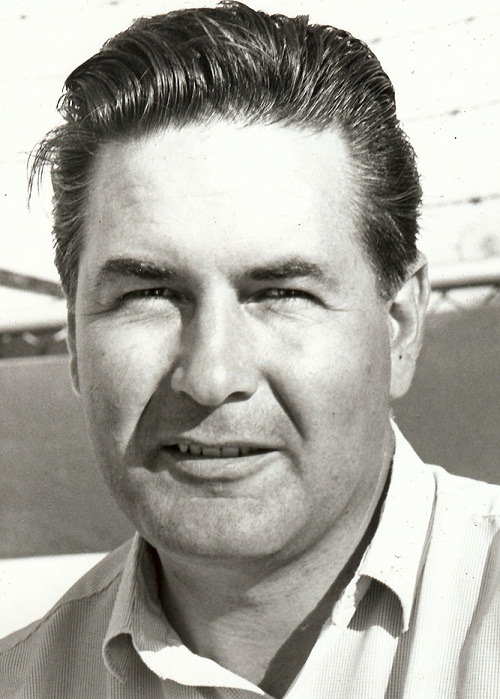
Howard Firby
Howard Firby
Coach | Inducted 2014
September 18, 1924 – March 30, 1991
Birthplace: Montgomery, Alabama, United States
Howard Firby was one of the great innovators of Canadian swimming and one of the most influential technical coaches of his era. A coach, artist, author, educator and sport builder, Firby helped transform Canada from an emerging swimming nation into an international contender while developing ideas about stroke mechanics that influenced coaches far beyond the athletes on his own pool deck.
Born to Canadian parents in Montgomery, Alabama, in 1924, Firby moved with his family to Saskatchewan as a child. During the Second World War, he served with the Royal Canadian Air Force and trained as a pilot. His time in the RCAF exposed him to the principles of aerodynamics—knowledge he would later adapt to the movement of swimmers through water.
Firby's path into swimming was shaped by adversity. While serving in the military, he contracted polio, severely affecting his right leg and ending his military career. During a lengthy recovery, he studied anatomy, kinetics and the function of his own muscles as part of the process of learning to walk normally again. Swimming became part of his rehabilitation. What began as a means of recovery ultimately developed into a lifelong study of how the human body moves through water.
After moving to Vancouver, Firby enrolled at the Vancouver School of Art and began working with the Vancouver Amateur Swim Club under legendary Canadian coach Percy Norman. Norman had coached Canada at the Olympic Games and was considered one of the country's foremost swimming authorities. Under his guidance, Firby began developing the combination of observation, experimentation and technical analysis that would become the hallmark of his coaching.
Firby's background as a professional artist gave him an unusual ability to communicate complex technical ideas visually.
He installed a blackboard near the pool and drew swimmers, body positions and stroke movements for his athletes. Rather than simply telling swimmers what they were doing incorrectly, he could show them. He later developed three-dimensional models to demonstrate body alignment and movement, combining his knowledge of anatomy with principles drawn from aerodynamics and hydrodynamics.
This technical approach made Firby one of swimming's leading authorities on stroke mechanics.
He believed efficiency through the water was fundamental to performance. Stroke technique was not something learned once and then forgotten; it required continuous observation, adjustment and refinement. His ideas were eventually collected in Howard Firby on Swimming, published in 1975 and illustrated by Firby himself. The book became an influential coaching text and remains closely associated with his reputation as one of the sport's great technical teachers.
In 1956, Firby helped establish the Canadian Dolphin Swim Club in Vancouver.
Beginning with only a small group of swimmers, the Dolphins became one of the dominant programs in Canadian swimming. Between 1961 and 1967, Firby's teams won six Canadian national team championships. His swimmers established more than 300 Canadian senior records and won more than 100 events at Canadian national championships.
The program also produced an extraordinary collection of international swimmers, including Mary Stewart, Helen Stewart Hunt, Margaret Iwasaki, Bill Slater, Jane Hughes and Elaine Tanner. International Swimming Hall of Fame records credit Firby's swimmers with world records and international Games victories across every swimming stroke.
Among the earliest examples of Firby's technical influence was Mary Stewart. Firby helped develop Stewart into one of the world's leading butterfly swimmers, and before the age of 17 she held Canadian records across freestyle and butterfly events and American records in butterfly.
His most celebrated athlete was Elaine “Mighty Mouse” Tanner.
Tanner joined the Canadian Dolphins as a young swimmer and developed under Firby's technically focused approach. Despite being smaller than many of her international competitors, Tanner emerged as one of the dominant swimmers of the mid-1960s. At the 1966 British Empire and Commonwealth Games in Kingston, Jamaica, she won four gold medals and became one of Canada's brightest international sport stars.
At the 1967 Pan American Games in Winnipeg, Tanner won the 100- and 200-metre backstroke and established world records in both events. A year later, at the 1968 Olympic Games in Mexico City, she won silver medals in the 100- and 200-metre backstroke and bronze as part of Canada's 4x100-metre freestyle relay, becoming the first Canadian woman to win three medals at a single Olympic Games.
Firby's influence also reached Olympic medallists from the next generation. Ralph Hutton, another swimmer associated with the Canadian Dolphins, became the first Canadian man in 48 years to win an Olympic swimming medal when he captured silver in the 400-metre freestyle at the 1968 Games.
As his club swimmers emerged internationally, Firby became an important figure on Canada's national teams.
He served as a Canadian coach at major international competitions and was Head Coach of Canada's swimming team at the 1964 Olympic Games in Tokyo and the 1966 Commonwealth Games in Kingston. His international coaching involvement helped introduce his technical philosophy to an even broader group of Canadian swimmers and coaches.
Yet some of Firby's most important contributions came away from international competition.
He was a founding figure in the organization that became the Canadian Swimming Coaches Association, serving as its first president. His leadership reflected a belief that raising the standard of Canadian swimming required not only better athletes, but better educated and better connected coaches.
That commitment became even more significant when Firby became Canada's first national swimming technical director.
Beginning in 1970, he travelled across the country teaching coaches and swimmers, visiting more than 200 grassroots clubs. His role allowed the technical knowledge he had developed in Vancouver to spread directly into programs throughout Canada. Through lectures, demonstrations and consultations, Firby helped establish a more systematic national approach to stroke instruction and coach development.
Firby was also determined to expose Canadian swimmers to world-class competition at home.
He founded an international meet in Vancouver that became known as the Canada Cup, designed to attract elite swimmers to British Columbia and give Canadian athletes regular opportunities to race international-calibre competition without always travelling abroad. The event eventually evolved into the Mel Zajac Jr. International Swim Meet, which remains an important fixture on the Canadian swimming calendar decades later.
Even after leaving the Canadian Dolphins, Firby continued coaching, consulting and teaching in programs across Canada. His influence reached multiple generations of athletes and coaches, and his reputation increasingly extended beyond Canada through lectures and coaching clinics around the world.
The international swimming community formally recognized that impact in 1985 when Firby was inducted into the International Swimming Hall of Fame as an Honor Coach. ISHOF credited him with 12 world-record holders, more than 300 Canadian senior record holders, nine International Games gold medals and a career that combined coaching with writing, illustration and technical education.
His Canadian honours were equally significant. Firby entered the BC Sports Hall of Fame as a Builder in 1977 and Canada's Sports Hall of Fame in 1979. He was later inducted into the Canadian Aquatic Hall of Fame, the Canadian Olympic Hall of Fame and Swimming Canada's Circle of Excellence before becoming a member of the inaugural class of the Canadian Swimming Coaches Association Hall of Fame in 2014.
Firby died in West Vancouver on March 30, 1991, at the age of 66.
His legacy remains embedded in Canadian swimming.
It can be seen in Elaine Tanner's Olympic medals and world records, in the national dominance of the Canadian Dolphins, and in the generations of swimmers whose technique reflected Firby's meticulous attention to how the body moved through water.
But perhaps his greatest contribution was his ability to turn technical knowledge into something coaches and swimmers could understand.
Firby combined the aerodynamics of a wartime pilot, the anatomical curiosity born from recovering from polio and the visual communication skills of a professional artist. From those unlikely ingredients emerged a distinctly modern approach to coaching—one based on observation, biomechanics, efficiency and continual technical refinement.
Through his athletes, his writing, his drawings, his national coaching education work and his leadership within the coaching profession, Howard Firby helped teach Canada how to swim faster.
Achievements
Career Highlights
Major Programs and Roles
Vancouver Amateur Swim Club
Founding Coach – Canadian Dolphin Swim Club
National Technical Director – Canadian Amateur Swimming Association
Founding member and first President – Canadian Swimming Coaches Association
Author and illustrator – Howard Firby on Swimming
Selected National Team Appointments
1958 British Empire and Commonwealth Games – Coach
1964 Olympic Games, Tokyo – Head Coach
1966 British Empire and Commonwealth Games, Kingston – Head Coach
Additional Pan American Games and Canadian national team assignments
Notable Athletes
Elaine Tanner, Mary Stewart, Helen Stewart Hunt, Margaret Iwasaki, Bill Slater and Jane Hughes
Selected Coaching Achievements
Six Canadian national team championships with the Canadian Dolphins
More than 300 Canadian senior records
More than 100 Canadian national championship victories
12 world-record holders credited by the International Swimming Hall of Fame
Nine International Games gold medals credited by ISHOF
Honours
BC Sports Hall of Fame – 1977
Canada's Sports Hall of Fame – 1979
Canadian Aquatic Hall of Fame – 1982
International Swimming Hall of Fame – Honor Coach, 1985
Canadian Olympic Hall of Fame – 2009
Swimming Canada Circle of Excellence – 2011
CSCA Hall of Fame – 2014